EFFECTIVENESS OF HOMOEOPATHIC MEDICINE ALUMINA IN CHRONIC CONSTIPATION
Dr. Varsha Dharane1 , Dr. Khusman Vaidya1, Dr. Smitha Nair1 , Dr. Ruta Patharkar1 , Dr. Deepali Paraskar1 , Dr. Ravind Yadav1 , Dr. Himika Bhargava1
Ayesha Patel2 , Khan Bushra2 , Shaikh Tahseen2
1Research Guide , 2Research Interns Motiwala Medical College And Hospital, Nashik, Maharashtra, India.
ABSTRACT
Background: Constipation is a common gastrointestinal symptom characterized by infrequent, difficult, or incomplete evacuation of hard stools. It is defined as the passage of stools less than three times per week or the need for excessive straining during defecation. It may result from a variety of causes, including inadequate dietary fiber intake, insufficient fluid consumption, lack of physical activity, or secondary to underlying diseases or medications.
Objective: To assess number of patients improved with Alumina in chronic constipation by measuring the proportion of patients across all age groups who has achieved a reduction of 3 or more than 3 points in MCAS score – after 6 months of treatment taken.
Methods: A prospective case series of 45 patients of all age group and both the genders, diagnosed with chronic constipation as per MCAS scale criteria, was conducted over a period of 6 months at Motiwala Homoeopathic Medical College and Hospital, Nashik. Homoeopathic medicine Alumina was prescribed as therapeutic on the basis of totality of symptoms, and MCAS score was recorded before and after the final follow-up. Pre- and post-treatment MCAS score were compared using the paired t-test.
Results: The mean MCAS score decreased from 12.09 before treatment to 7.20 after treatment. The mean reduction was 4.89 points, corresponding to an approximate 40.44% reduction from the pre-treatment mean. 40 out of 45 i.e 88.9% patients achieved a reduction of more than 3 points in MCAS score.
The paired t-test showed a highly statistically significant reduction in MCAS score (t(44) = 16.57, p < 0.001).
Conclusion: The present study concludes that Alumina demonstrated therapeutic effectiveness in the management of chronic constipation, as evidenced by improvement in the assessed constipation scores following treatment. Alumina may therefore be considered a homoeopathic therapeutic remedy indicated for constipation. At a functional level, its effect may be described as laxative-like; however, the present clinical study does not establish a specific pharmacological laxative mechanism.
Keywords: Chronic Constipation, Modified Constipation Assessment Scale, Case series, Alumina, Paired t-test
INTRODUCTION
Chronic constipation is a common gastrointestinal disorder affecting a substantial proportion of the population. Yet despite its frequency, many patients remain undiagnosed or undertreated. For instance, in a hospitalized adult patient, constipation was present in 55.6% of patients but often unrecognized by medical teams.
Significant impact on quality of life and healthcare utilization. Although sometimes regarded as a benign complaint, constipation can have considerable consequences. It negatively affects health-related quality of life, leads to increased healthcare visits, and may increase healthcare costs. Heterogeneity and gaps in knowledge, especially in India and within complementary medicine settings.
In India, local data are relatively scarce, particularly linking constipation to lifestyle, sociodemographic factors, and differing approaches of treatment (allopathy vs homeopathy).
Potential for modifiable risk factors and intervention. Many risk factors for constipation are modifiable — such as low fluid intake, low dietary fiber /vegetable intake, physical inactivity, certain medications, and comorbidities.
MATERIALS AND METHODS
Study Design and setting
A prospective case series of 45 patients of all age group and both the genders, diagnosed with chronic constipation as per MCAS scale criteria, was conducted in OPD of Motiwala Homoeopathic Medical College and Hospital, Nashik, Maharashtra, over a period of 6 months.
Sample
Forty-five (45) patients diagnosed with chronic constipation, of all age group, of either sex, satisfying the diagnosis criteria for MCAS scale and meeting the inclusion criteria, were enrolled by purposive sampling after obtaining written informed consent.
Inclusion Criteria
Exclusion Criteria
Outcome Measures
A reduction of 3 or more than 3 points in MCAS score – after 6 months of treatment taken.
Intervention
Homoeopathic medicine Alumina were selected for each patient as a therapeutic medicine on the basis of detailed case taking. Patient were followed up every 15 to 30 days over the 6-month study period, with potency and repetition adjusted according to response.
Statistical Analysis
Pre- and post-treatment MCAS scores were compared using the paired (dependent samples) t-test. A p-value of <0.05 was considered statistically significant.
RESULT
All 45 patients (100%) showed some reduction in MCAS score after treatment. 40 out of 45 i.e 88.9% patients achieved a reduction of more than 3 points in MCAS score.
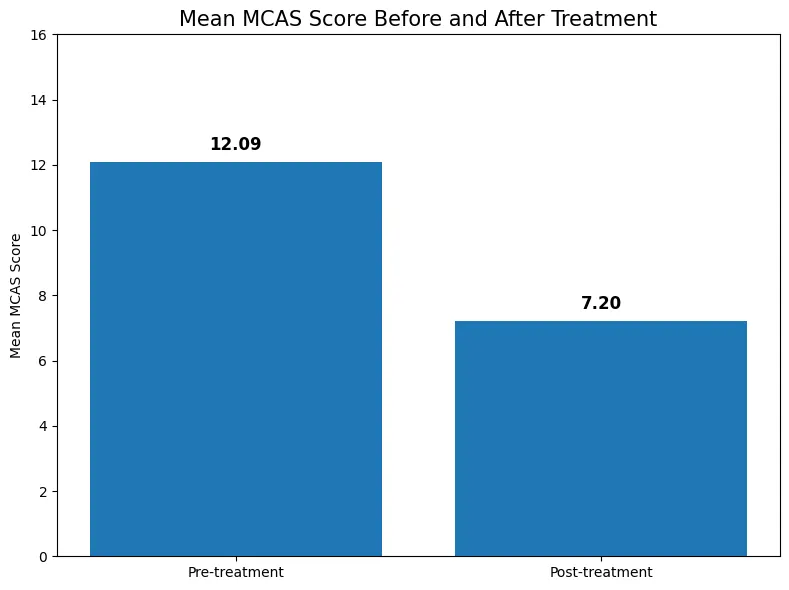
The mean MCAS score decreased from 12.09 before treatment to 7.20 after treatment. The mean reduction was 4.89 points, corresponding to an approximate 40.44% reduction from the pre-treatment mean.
Figure 1. Mean MCAS score before and after treatment.
DISCUSSION
The findings of the present study suggest that chronic constipation is improving in many patients following individualized prescribing of Alumina. An important point observed during the study was that improvement was not limited to bowel frequency. Patients also showed changes in hard stool, straining, painful defecation, bloating, flatulence and ineffectual urging. This is relevant because constipation affects several aspects of bowel function and cannot always be judged by frequency of stool alone.
Another interesting observation was the variation in response between patients. Some patients showed marked improvement, while others showed only partial improvement. Few cases also showed worsening of symptoms after a prolonged gap in follow-up. This indicates that the course of chronic constipation may vary between individuals and that regular follow-up is important when assessing treatment response.
The study also showed that patients did not present with exactly the same symptom pattern. Some mainly complained of hard stool and excessive straining, whereas others had prominent bloating, flatulence or painful defecation. This supports the importance of detailed individual case-taking rather than considering all constipation cases as identical.
Overall, the new observation from our study was that improvement appeared to involve several associated constipation symptoms and not only stool frequency. At the same time, the variable response and recurrence seen in few cases shows the need for longer and more systematic follow-up in future research.
CONCLUSION
This study looked at how well the homoeopathic medicine Alumina is useful in patients with chronic constipation. Forty-five patients were assessed using the Modified Constipation Assessment Scale (MCAS), once before treatment and again after six months.
The average MCAS score dropped from 12.09 to 7.20, a mean reduction of 4.89 points. This improvement was statistically significant (t (44) = 16.57, p < 0.001). 40 out of 45 patients i.e. 88.9 % patients achieved a reduction of more than 3 points in MCAS score
Importantly, improvement was seen not just in stool frequency but across other symptoms too, including hard stool, straining, painful defecation, bloating, flatulence and ineffectual urging. This suggests Alumina helped with the overall symptom burden of constipation, not just how often patients passed stool.
Not every patient responded the same way. Some improved a lot, others only partially. Few cases also showed worsening of symptoms after a prolonged gap in follow-up. Patients also did not all present with the same symptoms, which shows why individualised case-taking matters in treating chronic constipation.
ACKNOWLEDGEMENT
The authors thank Motiwala Medical College And Hospital, Nashik, Our Respected Mentors1 and all patients who participated in this study for their co-orperation.
REFERENCES
08:42 pm]
https://pmc.ncbi.nlm.nih.gov/articles/PMC11781917/[10-11-25 08:50 pm]
2025;63:174–183. Available from: https://www.sciencedirect.com/science/article/abs/pii/S2405457725003559 [10-11-25 09:32 pm]
Nutrients. 2022;14(9):1924. PubMed PMID: 35566314 [10-11-25 10:12 pm]
2021;2021:Article ID 5582763. [10-11-25 10:12 pm]
Systematic review and meta-analysis. Am J Clin Nutr. 2022; (3):635–649. [10-11-25 10:52 pm]
[10-11-25 10:52 pm]
Available from: https://www.worldgastroenterology.org/UserFiles/file/guidelines/constipationengl ish-2025.pdf [10-11-25 11:24 pm]
11:37 pm]
Updated meta-analysis. Clin Gastroenterol Hepatol. 2021; 19(7):1389–1399. [10-11- 25 11:43 pm]